Group3D: MLLM-Driven Semantic Grouping
for Open-Vocabulary 3D Object Detection

ECCV 2026

Youbin Kim1, Jinho Park1, Hogun Park1, Eunbyung Park2

1Sungkyunkwan University 2Yonsei University

Paper Code
🔤 Open-vocabulary Beyond fixed category taxonomy
🖼️ Multi-view RGB No point cloud or depth required
📷 Pose-free Works without camera poses
🎯 Zero-shot No 3D supervision required

Abstract

Open-vocabulary 3D object detection aims to localize and recognize objects beyond a fixed training taxonomy. In multi-view RGB settings, recent approaches often decouple geometry-based instance construction from semantic labeling, generating class-agnostic fragments and assigning open-vocabulary categories post hoc. While flexible, such decoupling leaves instance construction governed primarily by geometric consistency, without semantic constraints during merging. When geometric evidence is view-dependent and incomplete, this geometry-only merging can lead to irreversible association errors, including over-merging of distinct objects or fragmentation of a single instance. We propose Group3D, a multi-view open-vocabulary 3D detection framework that integrates semantic constraints directly into the instance construction process. Group3D maintains a scene-adaptive vocabulary derived from a multimodal large language model (MLLM) and organizes it into semantic compatibility groups that encode plausible cross-view category equivalence. These groups act as merge-time constraints: 3D fragments are associated only when they satisfy both semantic compatibility and geometric consistency. This semantically gated merging mitigates geometry-driven over-merging while absorbing multi-view category variability. Group3D supports both pose-known and pose-free settings, relying only on RGB observations. Experiments on ScanNet and ARKitScenes demonstrate that Group3D achieves state-of-the-art performance in multi-view open-vocabulary 3D detection, while exhibiting strong generalization in zero-shot scenarios.
Method

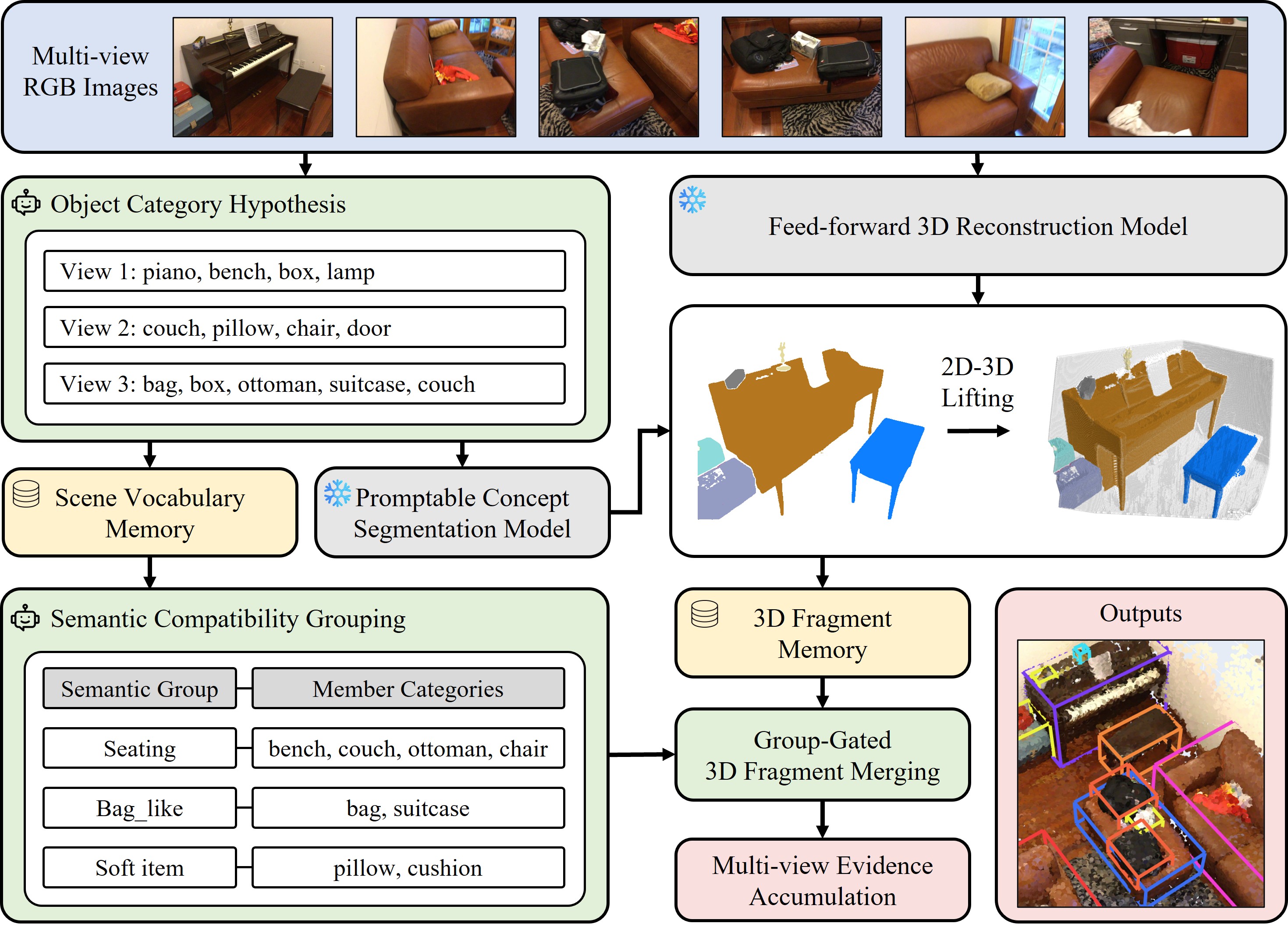
Group3D pipeline
Given multi-view RGB images, an MLLM predicts object categories across views, which are aggregated into a Scene Vocabulary Memory. Category-aware masks are lifted into 3D to construct a 3D Fragment Memory. The MLLM then organizes the vocabulary into semantic compatibility groups, which gate fragment merging together with geometric consistency to produce the final open-vocabulary 3D object instances. Finally, multi-view evidence is accumulated to determine the final open-vocabulary category and 3D bounding box for each object instance.

Quantitative Results

Method Pose-free Zero-shot ScanNet20 ScanNet60
mAP25 mAP50 mAP25 mAP50
Point cloud-based
Det-PointCLIPv2ICCV 23–✗––0.2–
3D-CLIPICML 21–✗––4.0–
OV-3DETCVPR 23–✗18.0–––
CoDaNeurIPS 23–✗19.3–9.0–
INHAECCV 24–✗––10.7–
GLISECCV 24–✗20.8–––
ImOV3DNeurIPS 24–✗21.5–––
OV-Uni3DETRECCV 24–✗25.3–19.4–
Zoo3D0CVPR 26–✓34.723.927.118.7
Zoo3D1CVPR 26–✗37.226.332.020.8
Multi-view image-based
OV-Uni3DETRECCV 24✗✗––11.2–
OpenM3DICCV 25✗✗19.87.3––
Zoo3D0CVPR 26✗✓30.517.322.010.4
Zoo3D1CVPR 26✗✗32.815.523.910.8
Group3D (Ours)✗✓51.127.429.113.9
Zoo3D0CVPR 26✓✓24.28.813.34.1
Zoo3D1CVPR 26✓✗27.910.415.35.6
Group3D (Ours)✓✓41.218.522.38.5

Zoo3D0 and Zoo3D1 denote two variants of Zoo3D: zero-shot and self-supervised.

We compare Group3D with prior open-vocabulary 3D detection approaches under two regimes, pose-known and pose-free. We focus exclusively on the multi-view RGB setting and report comparisons to both point cloud-based open-vocabulary detectors and multi-view image-based pipelines.

Method Pose-free Zero-shot ScanNet200 ARKitScenes
mAP25 mAP50 mAP25 mAP50
Posed images
OpenM3DICCV 25✗✗4.2–––
Zoo3D0CVPR 26✗✓14.36.2––
Zoo3D1CVPR 26✗✗16.56.3––
Group3D (Ours)✗✓17.98.720.55.9
Unposed images
Zoo3D0CVPR 26✓✓8.32.913.02.6
Zoo3D1CVPR 26✓✗10.73.816.13.5
Group3D (Ours)✓✓12.65.718.44.5

Zoo3D0 and Zoo3D1 denote two variants of Zoo3D: zero-shot and self-supervised.

Group3D consistently outperforms prior methods on ScanNet200 (200-category) and ARKitScenes in both pose-known and pose-free settings, demonstrating strong generalization to larger open-vocabulary taxonomies and cross-domain 3D scenes.

Qualitative Results

Ground Truth
Loading…
Pose-known
Loading…
Pose-free
Loading…
Ground Truth
Loading…
Pose-known
Loading…
Pose-free
Loading…
Ground Truth
Loading…
Pose-known
Loading…
Pose-free
Loading…
Ground Truth
Loading…
Pose-known
Loading…
Pose-free
Loading…
Ground Truth
Loading…
Pose-known
Loading…
Pose-free
Loading…

BibTeX

citation.bib
@article{kim2026group3d,
  title={Group3D: MLLM-Driven Semantic Grouping for Open-Vocabulary 3D Object Detection},
  author={Kim, Youbin and Park, Jinho and Park, Hogun and Park, Eunbyung},
  journal={arXiv preprint arXiv:2603.21944},
  year={2026}
}